

Outbound sales October 7, 2026 12 min read
What €1M+ SaaS Companies Get Wrong About Outbound
Discover why outbound fails for most SaaS companies past €1M ARR — the ICP, messaging, and process mistakes killing your pipeline in 2026.
Read MoreOutbound Hub insights
September 10, 2026 11 min read
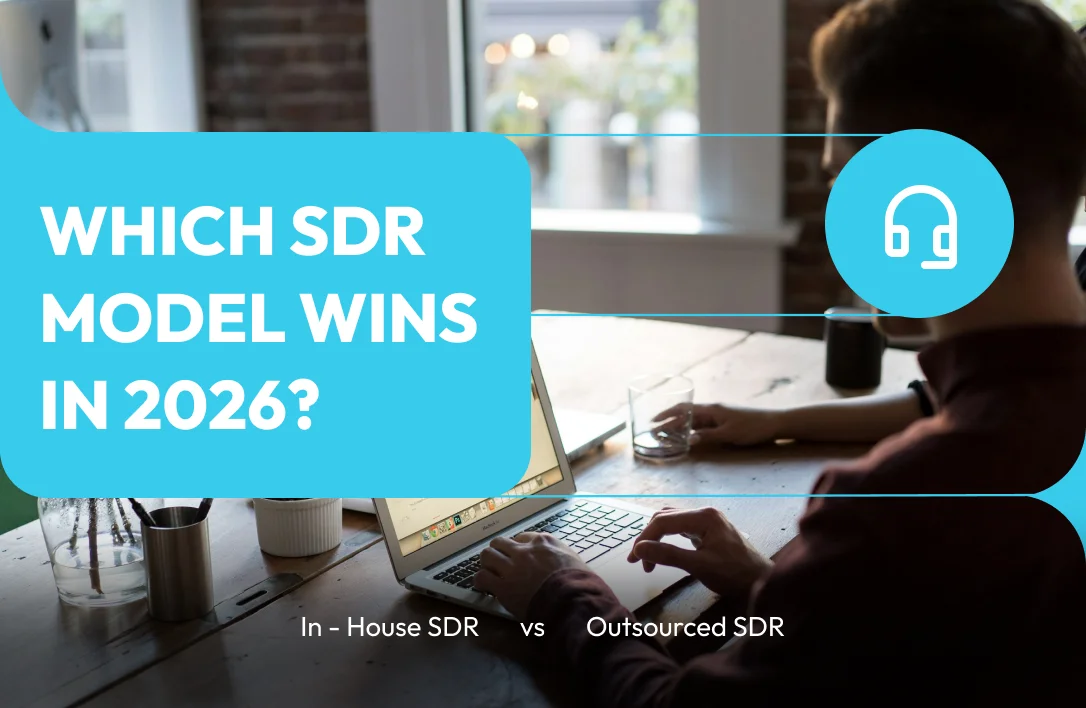
Every growing B2B company hits the same decision point sooner or later: do we build our own sales development team, or hand top-of-funnel prospecting to an outside provider? The question sounds simple, but the answer changes depending on your budget, your market maturity, and how much of a proven playbook you already have.
The internet is full of confident answers on both sides, most of them written by someone selling one option. This guide takes a more balanced view. We’ll break down what each model actually is, how they compare on cost, ramp time, control, and results, when each one makes sense, and how a hybrid approach can capture the best of both.
An in-house SDR team is a group of full-time employees whose job is to prospect, qualify leads, and book meetings for your account executives. They sit inside your company, report to your sales leadership, use your tools, and absorb your product knowledge and culture over time. You hire, train, manage, and pay them directly.
An outsourced SDR team, sometimes called SDR as a service, is an external provider that handles top-of-funnel prospecting, lead qualification, and meeting booking on your behalf. The provider supplies the people, and often the playbooks, data, and tools, while you supply the ICP, messaging guidance, and product context. Some run outreach from your domains and inside your CRM; others operate as a separate function that hands meetings over.
In-house SDRs are full-time employees you hire, train, and manage directly. Outsourced SDRs are provided by a third-party company that handles prospecting, qualification, and meeting booking for a monthly fee, usually with faster startup and less management overhead but less direct control.
At a glance, the two models trade off along a handful of lines. In-house offers deeper product knowledge, tighter control, and stronger long-term unit economics, but it takes longer to stand up and carries hiring and turnover risk. Outsourcing offers speed, flexibility, and lower first-year cost, but usually with less direct control and shallower product immersion. The sections below unpack each dimension.
This is where most decisions start, and where most comparisons go wrong. Comparing an outsourced retainer to an SDR’s base salary leaves out a large chunk of what an in-house seat actually costs.
A fully loaded in-house SDR, including base salary, commission, benefits and payroll taxes, tools, recruiting, management time, and ramp losses, commonly lands somewhere between $120,000 and $160,000 per year. Recruiting alone is often estimated at $15,000 to $25,000 per hire once agency fees and interview time are counted, and the tech stack (dialer, sequencer, data, CRM seats) typically adds another $6,000 to $13,000 annually per rep.
Outsourced SDR services generally run from around $3,000 to $8,000 per month, which works out to roughly $36,000 to $84,000 in year one, though pricing varies by provider, scope, and channel mix. Setup fees and minimum contract terms can add to that.
The cost picture also shifts over time. Outsourcing tends to win on year-one cost and speed. In-house can win on unit economics by year two or three, as reps build expertise and the team no longer pays for a provider’s margin. The number that matters most is cost per qualified meeting over a 12 to 24 month window, not the sticker price of either option.
A new in-house SDR typically needs somewhere around 4 to 6 months to reach full productivity, and building the whole function, hiring, tooling, playbooks, and training, can take even longer. On top of that, sales development turnover runs high, often cited at roughly 35 percent annually, so a meaningful share of your team is always in some stage of ramping or being replaced.
Outsourced providers can usually get outreach live in roughly 2 to 4 weeks, since they arrive with existing processes, tools, and experienced reps. That gap matters most when you need pipeline quickly or want to test a market before committing to headcount.
In-house teams need real management investment. A sales manager typically spends significant weekly hours on coaching, call reviews, and performance management, and that time comes out of what they’d otherwise spend on closing deals or strategy. Someone also needs to own onboarding, messaging updates, and process documentation.
Outsourced teams shift much of that burden to the provider, which handles day-to-day management and coaching internally. You still need to invest time in onboarding, sharing your ICP and messaging, and reviewing results regularly, but the ongoing management overhead is lighter.
In-house teams require you to buy, integrate, and maintain the full stack: CRM, sales engagement platform, data providers, dialer, and email infrastructure with proper deliverability safeguards. That’s a real cost and a real operational burden, especially for smaller teams without dedicated sales operations support.
Outsourced providers typically bring their own tools and infrastructure, which speeds up launch but can limit visibility. It’s worth confirming who owns the data, the sending domains, and the sequences, since those are assets you may want to keep if you ever move the function in-house.
Outsourcing is generally the more flexible model. Many providers can add capacity, open a new vertical, or pause a campaign without you hiring or laying off anyone, and contracts often run month to month or on shorter terms than the 12 to 24 month commitment that a full-time hire effectively represents. Teams often report being able to scale outbound campaigns much faster this way, since ramping a provider is quicker than ramping a new hire.
In-house scaling is slower but more deliberate. Each new rep is a longer-term investment, and the payoff comes from a team that deepens its expertise and compounds results over time.
This is the strongest argument for keeping SDRs in-house. Direct, day-to-day control over messaging, targeting, and priorities means faster iteration and tighter alignment with account executives. In-house reps also absorb your culture, product roadmap, and customer language in ways that are hard to replicate from outside.
Outsourced providers bring immediate market expertise and proven playbooks, but control is shared. Messaging changes may require approval loops, reporting can be limited, and quality depends heavily on how well the provider is briefed and how closely you manage the relationship. Industry experience suggests a significant share of outsourced engagements underperform, most often because of lead-quality mismatch or unclear expectations about what top-of-funnel work can deliver.
Both models can generate strong pipeline, and both can disappoint. In-house teams tend to perform best when there’s already a proven playbook, a clear ICP, and management capacity to coach. Outsourced teams tend to perform best when the target market is well defined, expectations are set around meetings and pipeline rather than closed revenue, and onboarding is thorough.
Whichever model you choose, measure it the same way: qualified meetings, show rate, meeting-to-opportunity conversion, and cost per qualified meeting, not just activity or booked-meeting counts.
In-house tends to make the most sense when:
Outsourcing tends to fit best when:
A practical decision path:
In-house SDRs are full-time employees you hire, train, and manage. Outsourced SDRs come from a third-party provider that handles prospecting and meeting booking for a monthly fee, usually with faster startup and less management overhead but less direct control.
Pricing varies, but many providers fall roughly between $3,000 and $8,000 per month, or about $36,000 to $84,000 in year one, depending on scope, channels, and setup fees.
Commonly around $120,000 to $160,000 per year once salary, commission, benefits, tools, recruiting, management time, and ramp losses are included.
Often around 2 to 4 weeks, since providers arrive with existing processes and tools.
Typically 4 to 6 months to full productivity, longer if you’re also building the process, tools, and training from scratch.
SDR as a service is an outsourced model where a provider supplies SDRs, and often tools and playbooks, to handle prospecting, qualification, and meeting booking, usually on a monthly contract.
Sales development turnover is often cited around 35 percent annually, which makes replacement and re-ramp costs a meaningful part of in-house budgeting.
Often estimated at $15,000 to $25,000 per hire once recruiter fees, interview time, and onboarding are included, though figures vary by market.
Roughly $6,000 to $13,000 per rep per year for CRM seats, sequencing, data, dialer, and email infrastructure.
Outsourcing usually costs less in year one and delivers faster startup. In-house can become more cost-efficient over two to three years, so cost per qualified meeting over time is the better comparison.
Ideally yes. New hires perform best executing a tested ICP and messaging framework, and they need manager coaching time to improve.
Yes. Outsourced teams let you test a vertical or region without committing to permanent headcount, which lowers the risk of an unproven strategy.
In-house teams. Direct day-to-day control over messaging, targeting, and priorities is a core advantage of building internally.
Many companies do. A common pattern is outsourcing to validate a market or handle overflow while in-house reps focus on core accounts, then shifting more in-house once the playbook is proven.
Assess your playbook maturity, management capacity, budget horizon, and how quickly you need pipeline, then compare cost per qualified meeting over 12 to 24 months.
Neither model wins outright. In-house SDR teams offer control, deep product knowledge, and stronger economics over the long run, but they need a proven playbook, real management time, and patience through a long ramp. Outsourced teams offer speed, flexibility, and lower year-one cost, but they work best with a clear brief, realistic expectations, and active oversight.
For many companies, the smartest answer is sequencing rather than choosing: use outsourcing to validate the market quickly, then build in-house around what works, or keep a hybrid model that uses each where it’s strongest.
Related articles
Outbound sales October 7, 2026 12 min read
Discover why outbound fails for most SaaS companies past €1M ARR — the ICP, messaging, and process mistakes killing your pipeline in 2026.
Read More
GTM strategy October 4, 2026 10 min read
Your ICP checks every box but deals still don't close. Here's why ICP targeting fails in B2B sales — and how to fix it with real data.
Read More
Outbound sales October 1, 2026 10 min read
Learn how to build a multi-channel outbound sequence that actually works in 2026 — channel mix, touch count, templates, and benchmarks.
Read More
Lead generation September 28, 2026 9 min read
Learn the 7 buying signals your sales team should track in 2026 — from pricing page visits to executive hires — and how to act on each one.
Read More
SDR September 25, 2026 10 min read
SDRs hitting their meeting quota but pipeline still falling short? Here's why booked meetings don't equal pipeline — and how to fix it.
Read More
GTM strategy September 22, 2026 11 min read
Why the foreign playbook doesn't work in Italy: cultural gaps, translation traps, and trust barriers, plus how to build an Italy-specific strategy.
Read More
Enterprise sales September 19, 2026 10 min read
Learn the best closing practices in Italy for 2026: build trust, find the real decision-maker, negotiate flexibly, and close B2B deals the Italian way.
Read More
Outbound sales September 16, 2026 11 min read
Is cold calling still effective in 2026? Get the latest benchmarks, best call times, scripts, compliance rules, and AI tips to book more meetings.
Read More
GTM strategy September 13, 2026 11 min read
Planning to sell software in Italy? This 2026 guide covers buyer behavior, business culture, outbound channels, localization, and common mistakes.
Read More