

Outbound sales October 7, 2026 12 min read
What €1M+ SaaS Companies Get Wrong About Outbound
Discover why outbound fails for most SaaS companies past €1M ARR — the ICP, messaging, and process mistakes killing your pipeline in 2026.
Read MoreOutbound Hub insights
September 25, 2026 10 min read
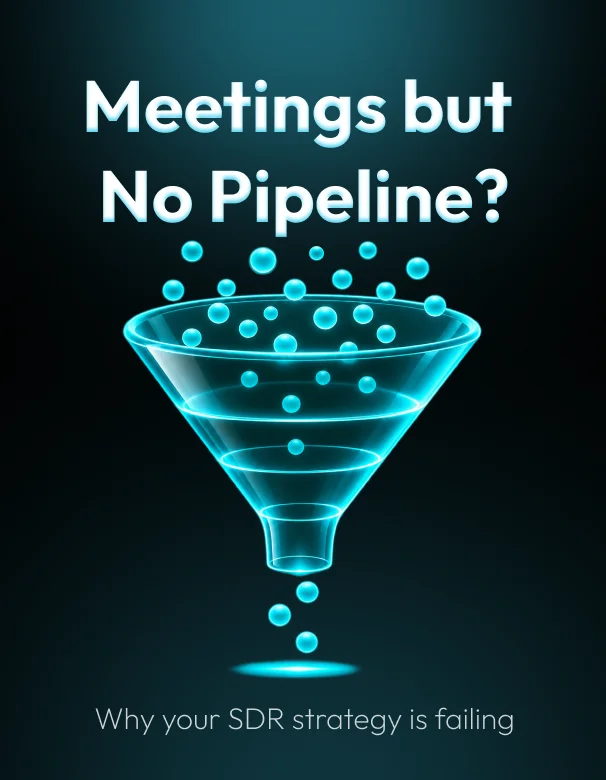
Your SDR team is crushing its meeting quota. The calendar is full, the activity dashboards look great, and every Friday standup ends with a high-five over “meetings booked.” Then the pipeline report comes out — and it doesn’t match the energy in the room.
If this sounds familiar, you’re dealing with one of the most common, and most misdiagnosed, problems in B2B sales development: SDR booking meetings not creating pipelines. It’s a gap that quietly drains revenue while everyone on the team looks busy and productive.
In this article, we’ll break down why booked meetings and real pipeline aren’t the same thing, what a healthy conversion rate looks like in 2026, the common mistakes that create this gap, the strategies and step-by-step process to fix it, and where AI and automation can genuinely help — without becoming another source of noise.
This is the root of almost every pipeline problem, so it’s worth getting precise before going further.
A booked meeting is simply a calendar invite that got accepted. Someone clicked a link, picked a time, and now there’s an event on the calendar. That’s it. It says nothing about whether the person is a real buyer, whether they have budget, or whether they even understand what the meeting is for.
A qualified meeting is one where the prospect matches your ideal customer profile, has a genuine business problem your product solves, and holds some level of authority or influence over a buying decision. It’s a meeting an Account Executive would actually want to take.
The gap between these two definitions is where the pipeline disappears. An SDR can hit “15 meetings booked” as a KPI while only five of those meetings are ones an AE is willing to accept. The other ten get politely declined, rescheduled into oblivion, or shown up to and immediately written off as a bad fit.
A booked meeting is any accepted calendar invite, regardless of fit. A qualified meeting is one where the prospect matches the ideal customer profile, has a genuine need, and holds real influence over the purchase — meaning it’s a meeting an AE will actually accept and work with.
Before diagnosing your own numbers, it helps to know what “healthy” actually looks like. Here’s roughly how the benchmarks shake out heading into 2026:
| Metric | Typical Benchmark |
|---|---|
| Meeting show rate | 70–80% (outbound), 85–90% (inbound) |
| Meeting-to-qualified-opportunity rate | Often targeted at roughly 50%+ for a healthy motion |
| SQL-to-opportunity conversion | Roughly 30–60%, depending on whether leads are inbound or SDR-sourced |
| Outbound qualified meetings per SDR/month | Typically 8–15, with top performers reaching 20+ |
These numbers shift by segment — enterprise deals convert differently than SMB — and by how strictly “qualified” is defined. Teams with tight ICPs and disciplined pre-meeting qualification tend to land at the higher end; teams optimizing purely for meeting volume tend to sit well below it.
A good SDR pipeline conversion rate generally means roughly half or more of qualified meetings should advance into a real sales opportunity. If your team converts well below that, the issue is more likely qualification quality than activity levels.
Most of the “why SDR meetings aren’t converting to opportunities” problem traces back to a small set of recurring mistakes.
When meeting count is the only metric that matters, reps naturally chase the easiest yes — even from someone who was never going to buy. This isn’t laziness; it’s incentive design. If the scorecard rewards volume, volume is what you’ll get.
Strong SDRs qualify before they book. Weaker processes push qualification into the AE’s lap, meaning the AE ends up doing discovery on a call that was supposed to already be vetted. By the time they realize the prospect isn’t a fit, the meeting has already counted toward quota — but it never becomes a real pipeline.
Low show rates get written off as “flaky prospects” far too often. In reality, they usually point to weak confirmation sequences or a prospect who never fully understood why the meeting mattered.
If SDRs and AEs don’t agree on what “qualified” means, friction shows up at the handoff. SDRs think they’re delivering pipeline; AEs think they’re being handed a list of tire-kickers. This disconnect alone can sink conversion rates without anyone realizing it’s a definition problem, not a talent problem.
A perfectly executed outreach sequence sent to the wrong company still produces a low-value meeting. If SDRs are working on a list that isn’t tightly matched to the ideal customer profile, even a great conversation won’t turn into a deal worth pursuing.
Not all qualified meetings carry the same revenue potential. Teams that don’t weight or prioritize meetings by deal size or fit end up spreading AE time thin across low-value conversations.
Once the mistakes are visible, the fix comes down to a few core strategic shifts.
Redefine what “success” means for SDRs. Move the core KPI from “meetings booked” to “qualified meetings accepted by AEs.” This single change realigns incentives almost overnight.
Build a shared qualification framework. Get SDR and AE leadership in a room and agree, in writing, on what a qualified meeting looks like: budget signals, authority, need, and timing, whatever fits your sale. Document it somewhere both teams reference constantly.
Tighten targeting before scaling outreach volume. More activity aimed at the wrong accounts just produces more low-quality meetings, faster. Fix the list before fixing the pitch.
Create a fast feedback loop between AEs and SDRs. AEs should be able to flag a bad meeting in a way that reaches the SDR quickly, not three weeks later in a QBR deck. Fast feedback is what actually changes behavior on the next call.
Segment meeting quality by account tier. Weight enterprise-fit meetings differently from SMB ones so SDRs aren’t incentivized to chase volume from smaller, lower-value accounts at the expense of strategic ones.
Strategy only works if it’s operationalized. Here’s a practical sequence for rolling it out:
Once the process is in place, a few ongoing habits keep it working:
AI tools are increasingly used to close this exact gap, and used well, they can meaningfully improve meeting quality rather than just meeting volume.
Pre-call research and scoring. AI can pull account and contact signals, funding events, hiring trends, tech stack changes — and flag which prospects are most likely to match the ICP before an SDR ever reaches out.
Conversation intelligence for qualification consistency. Call and email analysis tools can check whether SDRs are actually asking the agreed-upon qualification questions, rather than relying on manager spot-checks.
Automated confirmation and reminder sequences. AI-driven scheduling tools can personalize reminder messaging based on the prospect’s role or industry, which tends to improve show rates more than a generic reminder email.
AI-assisted lead scoring for prioritization. Instead of treating every inbound or outbound lead the same, scoring models can help SDRs focus time on accounts most likely to convert into real opportunities.
One caution worth noting: teams that lean entirely on AI-driven outreach sometimes see cost-per-meeting drop sharply while meeting-to-opportunity conversion drops even further, because volume increases faster than qualification improves. The most effective setups tend to pair AI for research, scoring, and administrative tasks with human judgment for the actual qualification conversation, not replace one with the other wholesale.
Usually because meetings are counted as wins the moment a calendar invite is accepted, regardless of prospect fit. Without pre-meeting qualification, low-intent or poor-fit prospects get booked just as easily as strong ones.
A booked meeting is any accepted invite. A qualified meeting is one where the prospect fits your ideal customer profile, has a real need, and holds buying influence — meaning an AE will actually want to work on it.
There’s no universal number, but many healthy motions aim for roughly half or more of qualified meetings converting into opportunities. Below that, it’s worth auditing your qualification process.
Ideally both — but pipeline generated, or at least AE-accepted meetings, should carry more weight than raw meeting count, since it’s the metric that actually correlates with revenue.
Not entirely. AI can improve targeting, research, and reminder sequences, but qualification judgment and discovery conversations still benefit from human skill. The strongest results come from pairing AI-assisted research with disciplined human qualification, not replacing one with the other.
Booked meetings feel like progress, but they’re only a leading indicator — not the finish line. If your SDR team is hitting its meeting numbers while the pipeline stays flat, the fix isn’t more activity. It’s better qualification, a shared definition of “qualified” across teams, a repeatable process, and the right use of AI to support, not replace, human judgment.
Start by auditing where your meeting-to-opportunity funnel is leaking, align your SDR and AE teams around one definition of a qualified meeting, and track pipeline outcomes rather than calendar invites as the real measure of SDR performance.
Related articles
Outbound sales October 7, 2026 12 min read
Discover why outbound fails for most SaaS companies past €1M ARR — the ICP, messaging, and process mistakes killing your pipeline in 2026.
Read More
GTM strategy October 4, 2026 10 min read
Your ICP checks every box but deals still don't close. Here's why ICP targeting fails in B2B sales — and how to fix it with real data.
Read More
Outbound sales October 1, 2026 10 min read
Learn how to build a multi-channel outbound sequence that actually works in 2026 — channel mix, touch count, templates, and benchmarks.
Read More
Lead generation September 28, 2026 9 min read
Learn the 7 buying signals your sales team should track in 2026 — from pricing page visits to executive hires — and how to act on each one.
Read More
GTM strategy September 22, 2026 11 min read
Why the foreign playbook doesn't work in Italy: cultural gaps, translation traps, and trust barriers, plus how to build an Italy-specific strategy.
Read More
Enterprise sales September 19, 2026 10 min read
Learn the best closing practices in Italy for 2026: build trust, find the real decision-maker, negotiate flexibly, and close B2B deals the Italian way.
Read More
Outbound sales September 16, 2026 11 min read
Is cold calling still effective in 2026? Get the latest benchmarks, best call times, scripts, compliance rules, and AI tips to book more meetings.
Read More
GTM strategy September 13, 2026 11 min read
Planning to sell software in Italy? This 2026 guide covers buyer behavior, business culture, outbound channels, localization, and common mistakes.
Read More
SDR September 10, 2026 11 min read
In-house vs outsourced SDR: compare cost, ramp time, control, and scalability to choose the right sales development model for your team in 2026.
Read More